
'A large portion of youngsters who aspire to join the civil services are not motivated by the spirit of public service and idealism of which the civil services offer in abundance.' 'When they join the mandarin club they look for the loaves and fishes of office, rather than make a difference and wipe what Mahatma Gandhi called 'every tear from every Indian',' points out Rup Narayan Das.

Slamming the Budget, senior Congress leader P Chidambaram on Saturday said the Modi government was in complete denial that the economy faces a "grave macro economic challenge" and it has given up on reviving the economy, accelerating growth or creating jobs. There is nothing in the Budget that leads one to believe that growth will revive in 2020-21 and the claim of 6 to 6.5 per cent growth next year is "astonishing and even irresponsible", the former finance minister said at a press conference.
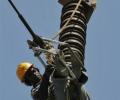
Electricity generation has outperformed the industrial production index for five months in a row this financial year, even as the broader economy is struggling to grow.

India and the US on Thursday said they are looking forward to the reconvening of the India-US Trade Policy Forum later this year to further enhance trade relationship and identify new areas for engagement.

'I feel that since they know the problems, in the next 2 to 3 quarters, these problems could be resolved.' 'But they should realise that things are not working well right now.'demonetisation did not have a huge negative impact on the economy. But when it comes to GST, those who are looking for loopholes find it difficult to adapt.

India will need an annual investment of Rs 15 trillion in infrastructure over the next five years, says Chandrajit Banerjee, DG, CII.

Jaitley promised higher investment in roads and railways.
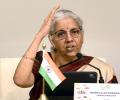
'I'm pitching India for the strengths we offer, including the English language, engineers, doctors, nurses, professionals, innovative talent of startups.'

Modi said that for nearly one and a half years he has been putting in place details of new schemes to give new pace to the country's development and curb poverty.

My sense is that we are in a situation similar to 2011-13, notes Debashis Basu.
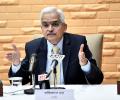
Reserve Bank of India governor Shaktikanta Das on Monday said payments through UPI (unified payment interface) have grown exponentially in the past 12 months with daily transactions crossing 36 crore, which is up 50 per cent from 24 crore in February 2022. In value terms, these transactions are worth Rs 6.27 lakh crore, registering a growth of 17 per cent from Rs 5.36 lakh crore in February 2022, the governor told reporters while launching the Digital Payments Awareness Week at the RBI headquarters in Mumbai this afternoon. He also said the overall monthly digital payment transactions crossed over Rs 1,000-crore-mark each month during the past three months.

Finance Minister Nirmala Sitharaman on Tuesday unveiled a Rs 39.45 lakh crore Budget with a view to fire up the key engines of the economy to sustain a world-beating recovery from the pandemic. This was Sitharaman's fourth Budget. While the taxpayers were left in the lurch, once again, was she able to cheer Corporate India?

The Reserve Bank on Wednesday hiked key benchmark policy rate by 25 basis points to 6.5 per cent, citing sticky core inflation. This is the sixth time interest rate has been hiked by the Reserve Bank of India (RBI) since May last year, taking the total quantum of hike to 250 basis points. Announcing the bi-monthly monetary policy, RBI Governor Shaktikanta Das said the Monetary Policy Committee (MPC) by a majority decided to raise the policy repo rate by 25 basis points and keep a 'strong vigil' on inflation outlook.

'Indian families' needs and expectations have gone through a revolution across economic demographics.' 'As this latest Modi-Sitharaman Budget demonstrated, politicians have understood this change. They are responding to it,' points out Shekhar Gupta.

The GDP growth fell to a nine-year low of 5.3 per cent in the first quarter, down from 9.2 per cent the same time last year.

Though the outcome of the general elections will offer a short-term boost to the market, a sustained rally will be determined by the economic data, according to a JP Morgan Asset Management report.

Singapore Airlines on Tuesday said Vistara will be merged with Tata group-owned Air India. Tata group owns a 51 per cent stake in Vistara, and the remaining 49 per cent shareholding is with Singapore Airlines (SIA). As part of the transaction, SIA will also invest Rs 2,058.5 crore in Air India.

'The BJP's real weapons are Hindutva, organisation and finance.'

Accusing the Congress of creating obstacles in the path of growth and economy, he declared that the government would try to get the bill passed with the help of parties

According to state officials, the project envisages lifting of 17.40 thousand million cubic feet of water from river Thunga to Bhadra reservoir and 29.90 TMC from Bhadra reservoir.
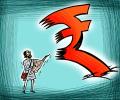
Barry Eichengreen, professor of economics and political science, University of California, Berkeley, analyzes the transparency of the Reserve Bank of India, the growth rate of the Indian economy and why he feels globalisation can never be rolled back.

Union Minister Kiren Rijiju on Tuesday said the Congress and other opposition parties have brought the no-confidence motion against the Narendra Modi government in the Lok Sabha at a 'wrong time and in a wrong manner'.

Infosys on Thursday posted a 7.8 per cent year-on-year rise in consolidated net profit at Rs 6,128 crore in March quarter of FY23, and gave 4-7 per cent revenue growth forecast for FY24 amid macro economic uncertainities. The net profit (after minority interest) stood at Rs 5,686 crore in the fourth quarter of FY22. Seen sequentially, the net profit for Q4 came in 7 per cent lower.

British Prime Minister Rishi Sunak on Monday unveiled a new scheme for the world's 100 most talented young professionals in the field of artificial intelligence (AI) as part of his vision to make the UK a "beacon" to attract the "brightest and best" from around the world. Addressing the Confederation of British Industry (CBI) annual conference in Birmingham, Sunak told an audience of business chiefs and professionals that control over the country's post-Brexit immigration policy remains crucial. However, he pledged to create "one of the world's most attractive visa regimes for entrepreneurs and highly skilled people" and make use of the "Brexit freedoms" to strike trade deals with "the world's fastest-growing economies".
.jpg)
Given the 18-day government shutdown in the US and the likelihood for continued wrangling between the Democrats and the Republicans, it now looks like tapering may be off the table till the first quarter of 2014.
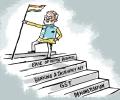
Three-quarters into the 10 years that Mr Modi had sought for transforming India, the 'output' numbers look impressive, but the key 'outcome' numbers don't show up much, if at all, observes T N Ninan.
.jpg)
Govt expects 15.8% growth in revenue collection this year.
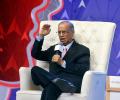
N R Narayana Murthy, co-founder of Infosys, blamed the venture capitalist community for inculcating a culture among entrepreneurs to chase growth at all costs. He said the VC model of investment looked like a ponzi scheme. "I would hold venture capitalists responsible who propounded the theory that only the top-line is important and not the bottom-line. "I think that is completely wrong. In many ways it looks like a ponzi scheme.

Finance Minister Ishaq Dar, who presented the budget in the National Assembly, the lower house of parliament, said the government will target a growth rate of 3.5 per cent in the coming fiscal year.
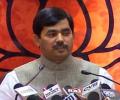
Hussain said the new government had inherited an "empty treasury" while the prices of oil were shooting up.

Prime Minister Modi has said it is their small units that drive the Indian economy.
Fresh investments by corporates up just 5.8% in FY17, lowest since 1992

Modi launched a scathing attack on the Congress alleging that the opposition party has become outdated and has always been against any kind of reservation.

'Modi has sowed the seeds of a transformational change.' 'For the sake of the nation and our children I hope he succeeds.'

From the Sensex pack, Reliance Industries fell the most by 2 per cent. Tata Steel, Bajaj Finserv, ITC, NTPC, Bharti Airtel, Tech Mahindra, Titan, Axis Bank and Bajaj Finance were among the other major laggards.

Here are the key numbers to watch out for in the Budget for 2022-23, which is widely expected to boost spending towards policies that create jobs, boost manufacturing, helping rural and agri-economy and infrastructure creation. Sitharaman, who had in her first budget in 2019 replaced leather briefcase -- which had been in use for decades for carrying budget documents -- with a traditional red cloth 'bahi-khata', has spurt in tax collections to her aid in the budget that is expected to a spend-all budget.

'A buoyant market economy is one which is led by the innovation and imagination of private persons,' notes Ajay Shah.

Days after completing a $6.5 billion acquisition of Ambuja Cements and ACC, billionaire Gautam Adani said his group has planned to double cement manufacturing capacity and become the most profitable manufacturer in the country. He saw a multifold rise in cement demand in India on the back of record-breaking economic growth and the government's infrastructure creation push, which will give significant margin expansion. In a speech made at an event to mark the completion of the acquisition on September 17, the Adani Group founder and chairman said the ports-to-energy conglomerate has in a single stroke become the second largest cement manufacturer in the country.
The employment situation remains dire. Whatever can be done to promote greater low-skill employment should be pursued aggressively, advises former chief economic adviser Shankar Acharya.
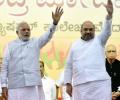
Rallying behind the government, the BJP decided to launch a counter-offensive against the opposition "disinformation campaign" on the controversial land bill with Prime Minister Narendra Modi asserting that his growth model was pro-poor.
